
CELEBRITY
PENSION TENSION: Sen. Mark Kelly is suing the War Department and War Secretary Pete Hegseth, alleging retaliation after he appeared in a video urging service members to “refuse illegal orders.” The lawsuit claims the Pentagon moved to demote Kelly and cut his military retirement pay following the message.

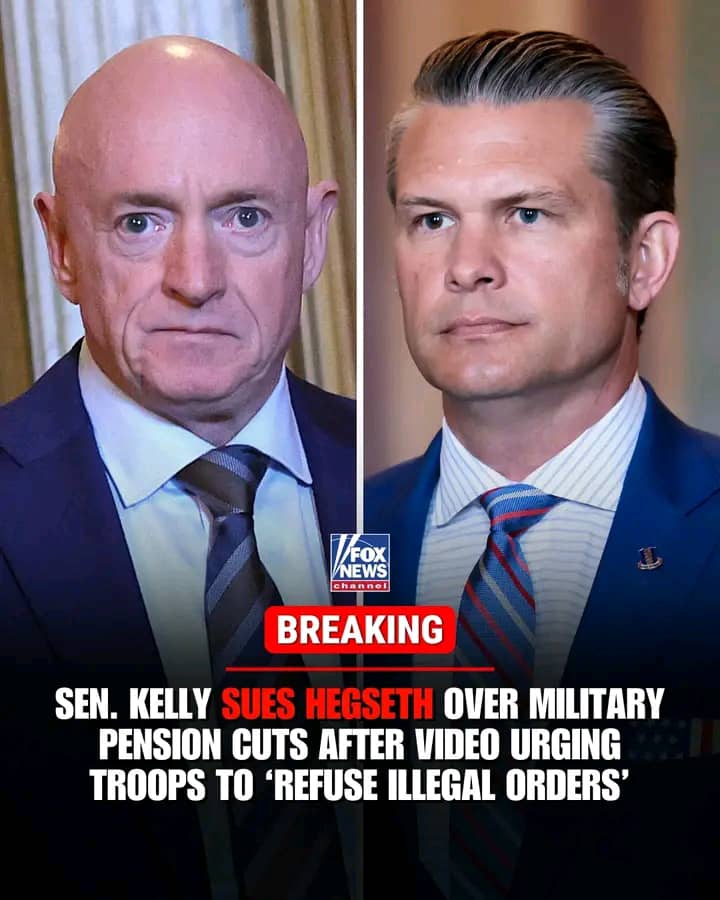
It began as a simple reminder about military duty — but for U.S. Senator Mark Kelly, that reminder has snowballed into a remarkable constitutional clash pitting a retired naval officer and sitting lawmaker against the highest reaches of the Pentagon.
In November 2025, Senator Kelly — a retired Navy captain and former astronaut — joined five other Democratic members of Congress in a video addressing U.S. service members. The video urged troops to remember their legal obligation to refuse unlawful orders, a principle long taught in military law and doctrine.
But what was intended as a constitutional reminder quickly turned into a political firestorm. President Donald Trump and Defense Secretary Pete Hegseth publicly blasted the message as undermining good order and discipline and even suggested it amounted to “seditious behavior.” Kelly and his colleagues drew intense criticism, and the Pentagon launched a review of Kelly’s remarks under military law.
From Censure to Lawsuit
On January 5, 2026, Hegseth took the extraordinary step of formally censuring Senator Kelly and initiating administrative proceedings to reduce Kelly’s retired rank — a step that would also cut his military retirement pay. Pentagon officials justified the action by saying that as a retired military officer, Kelly technically still falls under certain provisions of the Uniform Code of Military Justice.
Rather than accept the move quietly, Kelly escalated the conflict dramatically.
On January 12, 2026, he filed a federal lawsuit in Washington, D.C., naming Defense Secretary Pete Hegseth, the Department of Defense, and the Department of the Navy as defendants. In the complaint, Kelly argues that the Pentagon’s actions are retaliatory, unconstitutional, and designed to punish him for speech that is protected by the First Amendment.

A California federal judge hit the Trump administration with a scathing order to notify thousands of detained immigrants nationwide that they can join a lawsuit demanding either a hearing or immediate release.

Trump DOJ takes down thousands of Epstein docs after admitting it exposed victims

The Department of Justice was reportedly caught deleting evidence that sex trafficker Ghislaine Maxwell was in possession of three interviews that could possibly be used as blackmail over President Donald Trump and were not released to the general public.

Trump owes the Supreme Court an apology—to the Justices he smeared on Friday and the institution itself. He doubtless won’t offer one, but his rant in response to his tariff defeat at the Court was arguably the worst moment of his Presidency.

Former President Bill Clinton and former Secretary of State Hillary Clinton are in a standoff with House Oversight Committee Chair James Comer, R-Ky., over testimony the panel is seeking in its investigation into the late convicted sex offender Jeffrey Epstein.

Former President Bill Clinton and former Secretary of State Hillary Clinton are set to testify to the House Oversight Committee for its investigation into Jeffrey Epstein, a committee spokeswoman says.

Trump refuses to apologize after posting racist meme of the Obamas

In a rare move, the White House recently took down a racist post from one of President Trump’s social media accounts. Extremism researchers say it fits a pattern of mainstreaming extremist ideas.

Just hours after the federal judges in the Eastern District of Virginia appointed a new interim US attorney to replace Trump loyalist Lindsey Halligan, the administration said he is fired.

President Trump is asking the federal government for billions of dollars in damages, putting his own Justice Department on the spot and creating an unprecedented ethical morass.

A federal judge in Illinois quickly issued a restraining order after the Trump administration slashed more than $600 million in CDC grants
