
CELEBRITY
In a rare move, the White House recently took down a racist post from one of President Trump’s social media accounts. Extremism researchers say it fits a pattern of mainstreaming extremist ideas.

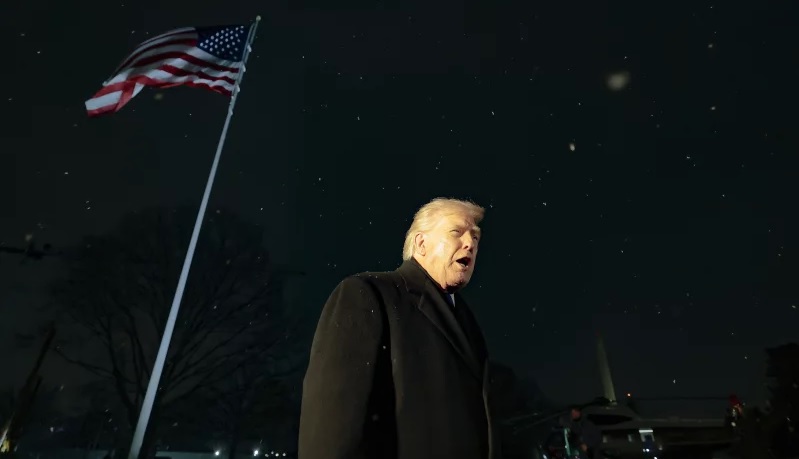
Extremist rhetoric is often found in government messaging. Who’s the target?
A recent social media post from an account belonging to President Trump prompted enough outcry over its use of a familiar racist trope that the White House deleted it. The Truth Social post included an image of former President Barack Obama and former first lady Michelle Obama as apes. Despite removing the post, Trump has deflected blame to an aide.
The former president commented on it over the weekend, calling it “deeply troubling” behavior.
For scholars and civil rights advocates steeped in the language and aesthetics of white nationalism, Trump’s post was remarkable only because of how overtly racist the trope is. But they say that it fits into a pattern of extremist rhetoric, visual material and other media that have overtaken public messaging from federal agencies over the past year. They say that much of that messaging may not have been detectable to most Americans who are not immersed in the study of extremism. But to those who are, the dog whistles and coded words have been unmistakable.
“If this were just one racist image or one bad post, it wouldn’t matter much,” said Eric Ward, executive vice president of Race Forward, a civil rights organization. “What matters is that over the last year, the Trump administration [is] abusing federal authority, and the federal government has increasingly learned to speak in the emotional language of white nationalism.”
While the latest controversy is over a post from a Trump social media account, Ward and others say the Department of Homeland Security has been behind the most, and the most notable, examples of extremist themes in federal messaging. In its effort to recruit large numbers of new immigration enforcement agents, the federal agency has generated a body of propaganda that has raised alarm over its echoes of extremist movements.

A California federal judge hit the Trump administration with a scathing order to notify thousands of detained immigrants nationwide that they can join a lawsuit demanding either a hearing or immediate release.

Trump DOJ takes down thousands of Epstein docs after admitting it exposed victims

The Department of Justice was reportedly caught deleting evidence that sex trafficker Ghislaine Maxwell was in possession of three interviews that could possibly be used as blackmail over President Donald Trump and were not released to the general public.

Trump owes the Supreme Court an apology—to the Justices he smeared on Friday and the institution itself. He doubtless won’t offer one, but his rant in response to his tariff defeat at the Court was arguably the worst moment of his Presidency.

Former President Bill Clinton and former Secretary of State Hillary Clinton are in a standoff with House Oversight Committee Chair James Comer, R-Ky., over testimony the panel is seeking in its investigation into the late convicted sex offender Jeffrey Epstein.

Former President Bill Clinton and former Secretary of State Hillary Clinton are set to testify to the House Oversight Committee for its investigation into Jeffrey Epstein, a committee spokeswoman says.

Trump refuses to apologize after posting racist meme of the Obamas

In a rare move, the White House recently took down a racist post from one of President Trump’s social media accounts. Extremism researchers say it fits a pattern of mainstreaming extremist ideas.

Just hours after the federal judges in the Eastern District of Virginia appointed a new interim US attorney to replace Trump loyalist Lindsey Halligan, the administration said he is fired.

President Trump is asking the federal government for billions of dollars in damages, putting his own Justice Department on the spot and creating an unprecedented ethical morass.

A federal judge in Illinois quickly issued a restraining order after the Trump administration slashed more than $600 million in CDC grants
