
CELEBRITY
BREAKING: FEDERAL JUDGE BLOCKS ICE FROM USING PEPPER SPRAY OR ARRESTING PEACEFUL PROTESTERS — MAJOR LEGAL WIN IN MINNESOTA

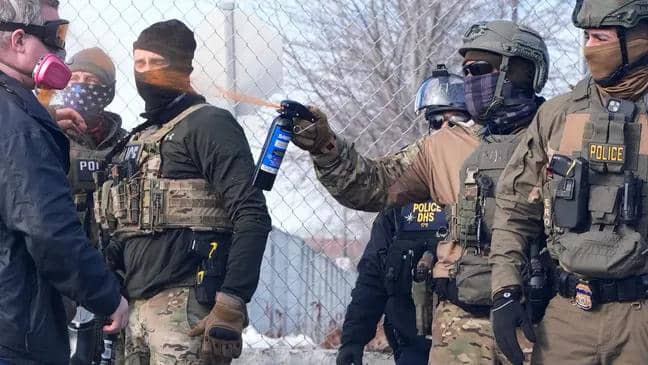
In a dramatic ruling Friday, a federal judge in Minnesota issued a sweeping injunction restricting federal immigration agents’ actions against demonstrators — baring them from using pepper spray, arresting, detaining, or retaliating against people engaged in peaceful, non-obstructive protests or observing enforcement activity.
U.S. District Judge Katherine Menendez delivered the order in response to a lawsuit brought by local residents and civil-rights groups, who argued that Immigration and Customs Enforcement (ICE) and other agents violated constitutional rights during a surge of federal immigration enforcement dubbed Operation Metro Surge in the Minneapolis–Saint Paul area.
A Decisive Legal Restriction
Under the preliminary injunction:
Federal agents cannot use pepper spray, tear gas, or similar non-lethal crowd-control tools against individuals engaging in peaceful protest or simply observing enforcement activity.
Agents are barred from arresting or detaining anyone participating in non-violent protest unless there is probable cause or reasonable suspicion that the person committed a crime or impeded law enforcement.
The ruling also prohibits retaliation against peaceful protesters for their protected speech or conduct.
The court further clarified that safely following federal agents’ vehicles at a reasonable distance — a tactic used by many observers tracking ICE activities — does not by itself justify a traffic stop or detention.
What Comes Next
The injunction is part of ongoing litigation over the sweep of federal immigration enforcement in Minnesota, which has drawn intense scrutiny after the fatal shooting of a Minneapolis woman by an ICE agent earlier this month.
Protesters and legal advocates hailed the ruling as a major protection of First Amendment rights, with Minnesota Attorney General Keith Ellison calling it an “important preliminary win for all Minnesotans exercising their constitutional right to peaceful protest.”
Pushback From DHS
In response, the Department of Homeland Security defended its actions, asserting its agents are trained to uphold the law and protect public safety amid what it describes as violent interference with federal enforcement. DHS officials have framed some protester conduct as dangerous or obstructive, and emphasized their constitutional mandate to enforce federal immigration laws.
A Moment of National Attention
The decision is likely to reverberate well beyond Minnesota. It places clear judicial limits on how federal immigration agents may engage with peaceful protestors — a significant development in a broader national debate over civil liberties, federal enforcement powers, and public dissent.
Critics of the ruling argue it could constrain law enforcement flexibility during complex operations. Supporters say it reaffirms constitutional protections at a time of heightened tension between federal authorities and communities protesting immigration tactics.
As the injunction takes effect, both sides are expected to continue pressing the legal battle — and the nation will be watching how the enforcement environment in Minneapolis evolves in response.

A California federal judge hit the Trump administration with a scathing order to notify thousands of detained immigrants nationwide that they can join a lawsuit demanding either a hearing or immediate release.

Trump DOJ takes down thousands of Epstein docs after admitting it exposed victims

The Department of Justice was reportedly caught deleting evidence that sex trafficker Ghislaine Maxwell was in possession of three interviews that could possibly be used as blackmail over President Donald Trump and were not released to the general public.

Trump owes the Supreme Court an apology—to the Justices he smeared on Friday and the institution itself. He doubtless won’t offer one, but his rant in response to his tariff defeat at the Court was arguably the worst moment of his Presidency.

Former President Bill Clinton and former Secretary of State Hillary Clinton are in a standoff with House Oversight Committee Chair James Comer, R-Ky., over testimony the panel is seeking in its investigation into the late convicted sex offender Jeffrey Epstein.

Former President Bill Clinton and former Secretary of State Hillary Clinton are set to testify to the House Oversight Committee for its investigation into Jeffrey Epstein, a committee spokeswoman says.

Trump refuses to apologize after posting racist meme of the Obamas

In a rare move, the White House recently took down a racist post from one of President Trump’s social media accounts. Extremism researchers say it fits a pattern of mainstreaming extremist ideas.

Just hours after the federal judges in the Eastern District of Virginia appointed a new interim US attorney to replace Trump loyalist Lindsey Halligan, the administration said he is fired.

President Trump is asking the federal government for billions of dollars in damages, putting his own Justice Department on the spot and creating an unprecedented ethical morass.

A federal judge in Illinois quickly issued a restraining order after the Trump administration slashed more than $600 million in CDC grants
