
CELEBRITY
Trump’s Iran Defense Sparks Fierce Backlash as Critics Question His Fitness for Office

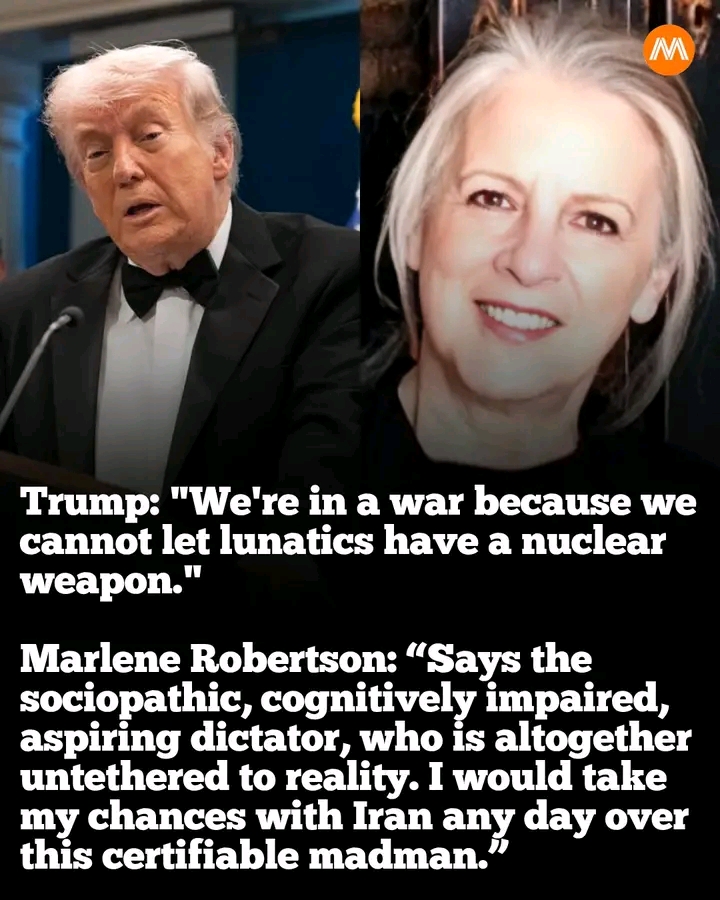
Political tensions exploded online after President Donald Trump defended continued U.S. involvement in the escalating Iran conflict with a blunt and controversial warning: “We cannot let lunatics have a nuclear weapon.” The remark, delivered during a fiery public appearance, immediately ignited fierce debate across social media and political circles
Trump framed the conflict as a necessary step to prevent Iran from obtaining nuclear capabilities, repeating a position he has emphasized for years. His supporters praised the statement as a show of strength and national security resolve, while critics argued the language was reckless and dangerously inflammatory
Among the loudest voices pushing back was political critic Marlene Robertson, who sharply condemned Trump in a viral response that quickly gained traction online. Robertson accused the former president of displaying authoritarian tendencies and openly questioned his mental fitness for office, arguing that his rhetoric was deepening global instability rather than calming it.
Her criticism unleashed another wave of political warfare online, with supporters and opponents clashing over whether Trump’s aggressive posture toward Iran reflects strong leadership or dangerous escalation. Some users defended his hardline stance on nuclear weapons, while others argued that his language risked inflaming an already volatile geopolitical crisis.
The controversy arrives amid mounting global anxiety surrounding tensions between the United States and Iran. Trump has repeatedly insisted that preventing Iran from acquiring nuclear weapons remains one of his top foreign policy priorities, declaring on multiple occasions that the world “cannot allow” such a scenario to happen.
As reactions continue to pour in, the political storm surrounding Trump’s remarks shows no sign of slowing down. What began as a defense of military involvement has now evolved into a broader national argument over leadership, rhetoric, and the future direction of U.S. foreign policy.

Supreme Court Delivers Major Blow to Trump’s Tariff Agenda in Landmark 6–3 Decision

Trump’s Iran Defense Sparks Fierce Backlash as Critics Question His Fitness for Office

JUST IN: Zelensky just bluntly accused JD Vance of actively helping Russia by trying to kill US military aid, warning that cutting off Ukraine fundamentally weakens America. 🇺🇦🇺🇸🇷🇺⚔️

Kylie Kelce Breaks Down After Wyatt’s Heart-Melting Message for Auntie Tay 💔💖

Taylor Swift and Travis Kelce Just Stole the Spotlight with an Early Kentucky Oaks Arrival—But One Odd Detail Has Everyone Confused.

Taylor Swift and Travis Kelce Spark Emotional Frenzy With Surprise Live Reveal That Left Fans Speechless

THIS WILL BE MY FINAL TOUR” — Taylor Swift’s Announcement Leaves Fans Speechless 💔 Six words. Simple yet heavy, they hit like a note you never expected to hear.

Get ready to have your heart stolen — again! NFL Legend Jason Kelce BEAMS with pride and MELTS the Internet as 7-Month-Old Baby Finnley Tugs, Twists, and Giggles at Dad’s Iconic Beard in the Most Adorable Father-Daughter Moment Ever! The Cutest Father-Daughter Moment You’ll See All Week — Fans everywhere are swooning over the Kelce family charm. Between Jason’s beard, baby Finnley’s irresistible laughter, and the undeniable love radiating from the clip, this moment has officially broken the internet — for all the right reasons. 💕Tap to Watch the Video Everyone’s Obsessing Over! 📲✨

Kylie Kelce had a funny yet honest critique for her husband Jason Kelce after their daughter Wyatt returned home from a solo golf outing with Dad.

Taylor Swift Charms Fans with Sweet Glimpse of Kylie Kelce’s Creative “Work Corner” During Pennsylvania Visit

Congratulations, Jason! Kylie Shares an Ultrasound Confirming they are expecting Child: The ultrasound shows the baby’s face and tiny heartbeat as the couple embrace in pure joy and reveals baby gender 😊
