
CELEBRITY
BREAKING: Trump Frames Border Crisis as Invasion, Signals Tough New Tech Measures to Protect U.S. Sovereignty

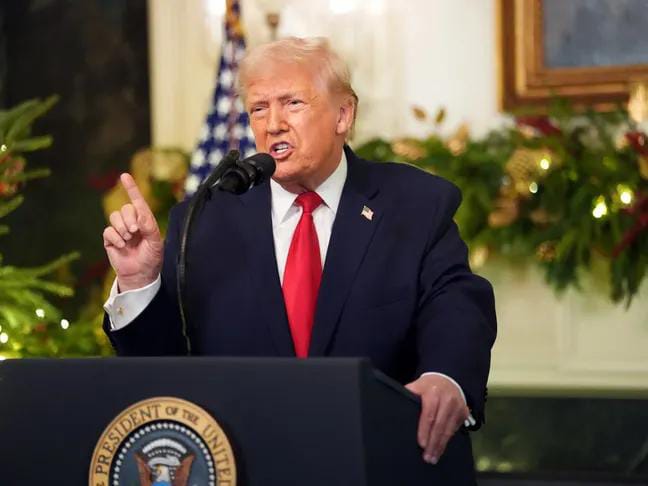
In an increasingly heated debate over border security and national sovereignty, former U.S. President Donald Trump has been depicted by allies and some media supporters as taking a hard-line stance on migration and aerial security, framing the current situation as a large-scale criminal incursion rather than ordinary migration.
Though no official White House release has matched the exact wording cited in social posts today, the broader theme echoes Trump’s long-standing narrative that the southern border represents a crisis of crime and national security, a claim he has repeatedly made in speeches and interviews during and after his presidency.
Border Rhetoric Escalates
During his time in office and beyond, Trump often used forceful language to describe unauthorized immigration and border crossings, calling them an “invasion” and asserting that criminal elements, including drug traffickers and gangs, were crossing into the United States. In remarks dating back to his 2019 national emergency declaration on the southern border, Trump tied border flows to crime and human trafficking, urging Congress to strengthen enforcement.
A portion of that rhetoric — widely circulated online — includes references to migrants coming from prisons and mental institutions, a claim Trump has made repeatedly without publicly available evidence.
Aerial Security and Anti-Drone Technology
The idea of using advanced technology to secure U.S. airspace has recently become a flashpoint. Federal aviation authorities temporarily closed airspace over El Paso, Texas, citing “special security reasons,” triggering confusion and political attention. Initial government claims referenced suspected incursions by unauthorized aerial objects, which some officials suggested could be drones related to criminal activity.
Subsequent reporting revealed that what was initially described as a possible drone may have been a balloon — and that anti-drone technology, including high-energy laser systems provided by the Pentagon, was tested and used in the region. The Federal Aviation Administration lifted the airspace restrictions within hours after determining there was no ongoing threat to general aviation.
Mexican officials have pushed back against assertions that any aerial incursion originated from cartel activity, noting there is no confirmation of drones entering U.S. airspace from Mexico during the incident.
Concerns over drones at the border are not entirely abstract. Recent defense reporting notes that Mexican drug cartels have utilized unmanned aerial systems for surveillance and smuggling — though mostly within Mexican territory — and that U.S. authorities detect frequent drone activity near the southern border.
President Trump’s political narrative has leaned heavily on the idea that evolving technologies pose new threats — and that the United States must respond forcefully to safeguard sovereignty and security.

COUPLE OF THE YEAR Travis Kelce AND Taylor Swift Hijack Wedding Reception With Secret Romantic Moment YOU CAN ONLY IMAGINE WHAT THE LOVEBIRDS WEDDING WILL LOOK LIKE AFTER BOTH EXCHANGED A ROMATIC GESTURE SECRETLY THAT LEAVES FANS IN AWE

BREAKING: Trump Frames Border Crisis as Invasion, Signals Tough New Tech Measures to Protect U.S. Sovereignty

A blistering exchange on the House floor intensified scrutiny this week over two shocking deaths in Minnesota involving federal immigration enforcement, as Rep. Hassan (D-Minn.) accused colleagues of failing to acknowledge the names of the victims while defending controversial federal actions.

RESIGN OR FACE IMPEACHMENT”: Rep. Ted Lieu Unleashes Blistering Warning at Pam Bondi in Explosive Capitol Clash

Kylie Jenner Goes Nearly Nude as she modeled the new SKIMS Everyday Cotton collection in a series of steamy photos Alongside Sister Kim Kardashian

Serena Williams displays sculpted physique in micro shorts after 34lbs weight loss transformation during pole dancing workout

Capitol Firestorm: AOC Slams public Says Pam Bondi “Doing Exactly What Her Boss Hired Her to Do

Rep. Jasmine Crockett closed with a blistering indictment of Pam Bondi: “You will be remembered as one of the worst attorneys general in history — one who chose obstruction over justice, corruption over the law, and loyalty to a president over loyalty to the Constitution.”

🚨 BREAKING: Six Republicans side with Democrats as the House overturns Trump’s Canada tariffs — a significant setback for the former president.

HUGE BREAKING: Republicans will LOSE MAJORITY in the House as soon as NEXT WEEK, according to reports that a Republican Rep. Neal Dunn (R-FL) will announce an early retirement. That exit that would drag the House Republican majority out the door with him. This is very, very good news.

At the Epstein hearing today, Rep. Jayapal asked all the Epstein victims to raise their hand if AG Pam Bondi/DOJ has refused to meet with them. All of them raised their hands. Every. Single. One.
