
CELEBRITY
BREAKING: The Supreme Court Issues Emergency Injunction Temporarily Restricting Key ICE Enforcement Actions in Minnesota as Legal Challenges Move Forward After State Files Lawsuit Alleging Constitutional Violations, ICE killing and Unlawful Use of Force Under the Donald Trump Administration

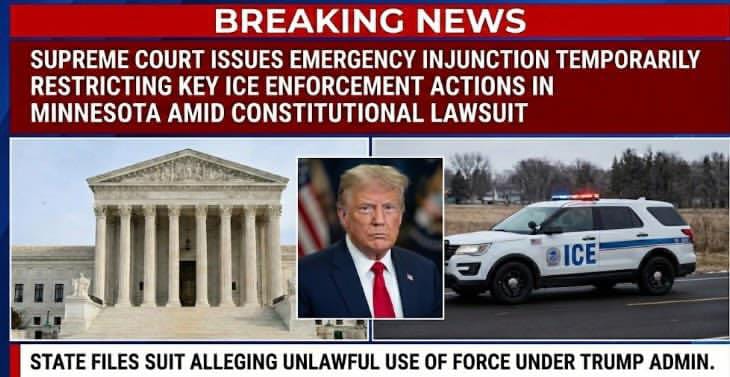
In the bitter chill of early January 2026, Minneapolis and Saint Paul found themselves at the center of a legal and constitutional storm that could define the boundaries of federal power and civil liberties for years to come.
What began as an aggressive immigration enforcement campaign — dubbed Operation Metro Surge by federal authorities — quickly escalated into an intense confrontation between the State of Minnesota and the federal government. The surge sent more than 2,000 agents from the Department of Homeland Security (DHS), including Immigration and Customs Enforcement (ICE) and Customs and Border Protection, into the Twin Cities to conduct raids and apprehensions across neighborhoods, workplaces, and public spaces.
Tensions erupted on January 7, 2026, when an ICE officer shot and killed 37-year-old Renee Nicole Good, a local woman who had been observing law enforcement activity from her vehicle. The incident, captured in video and widely shared across social media, drew national outrage, sparked sustained protests in Minneapolis and beyond, and ignited a fierce debate over the use of force by federal immigration agents.
In response, Minnesota Attorney General Keith Ellison, joined by the mayors of Minneapolis and Saint Paul, filed a dramatic federal lawsuit against the DHS and ICE officials. The complaint accuses the Trump administration of unleashing a “federal invasion” on Minnesota soil — violating constitutional protections and trampling on the rights of ordinary citizens.
The lawsuit does not merely contest administrative tactics; it challenges the very legitimacy of the large-scale enforcement push. It argues that the operation violates the First Amendment by suppressing speech and peaceful assembly, violates the Tenth Amendment by commandeering state resources and eclipsing local authority, and undermines the equal sovereignty of states by subjecting Minnesota to extraordinary federal enforcement not seen elsewhere. It also asserts violations of the Administrative Procedure Act, claiming DHS actions are arbitrary, capricious, and lacking lawful basis.
Facing a cascade of arrests, reports of warrantless detentions, aggressive use of force, and broad disruptions to everyday life — including schools forced into lockdown and businesses shuttered — the state and cities sought emergency judicial relief. Their request included a temporary restraining order and a preliminary injunction to immediately halt or curb the federal surge and to restrict enforcement tactics — such as barring force against bystanders, requiring visible identification on agents, and limiting operations in sensitive locations like schools and hospitals.
However, in the initial federal hearing, the judge declined to issue an immediate injunction. She noted the gravity of the allegations but emphasized the novel and complex constitutional issues raised by the case, giving federal officials time to respond before she considers whether to limit ICE’s actions.
Meanwhile, tensions remain high on the streets of Minneapolis, where protests continue and community leaders lament what they describe as an occupation of their neighborhoods. Local officials and civil rights activists argue that Minnesota’s lawsuit represents not just a fight over immigration policy, but a stand for constitutional protections and accountability in the face of extraordinary federal power.
Across the legal landscape, similar lawsuits are taking shape in other states — notably Illinois — pushing back against expansive federal immigration enforcement tactics and the use of force in civil contexts.
For now, the case will proceed through federal court, possibly to appellate review and, ultimately, could land before the U.S. Supreme Court. Whether that arises and what form such review might take is still uncertain. What is clear is that the clashes in Minnesota have sparked a broader conversation about the balance between federal authority, state sovereignty, constitutional rights, and how far enforcement agencies can go in pursuit of federal policy objectives.

A California federal judge hit the Trump administration with a scathing order to notify thousands of detained immigrants nationwide that they can join a lawsuit demanding either a hearing or immediate release.

Trump DOJ takes down thousands of Epstein docs after admitting it exposed victims

The Department of Justice was reportedly caught deleting evidence that sex trafficker Ghislaine Maxwell was in possession of three interviews that could possibly be used as blackmail over President Donald Trump and were not released to the general public.

Trump owes the Supreme Court an apology—to the Justices he smeared on Friday and the institution itself. He doubtless won’t offer one, but his rant in response to his tariff defeat at the Court was arguably the worst moment of his Presidency.

Former President Bill Clinton and former Secretary of State Hillary Clinton are in a standoff with House Oversight Committee Chair James Comer, R-Ky., over testimony the panel is seeking in its investigation into the late convicted sex offender Jeffrey Epstein.

Former President Bill Clinton and former Secretary of State Hillary Clinton are set to testify to the House Oversight Committee for its investigation into Jeffrey Epstein, a committee spokeswoman says.

Trump refuses to apologize after posting racist meme of the Obamas

In a rare move, the White House recently took down a racist post from one of President Trump’s social media accounts. Extremism researchers say it fits a pattern of mainstreaming extremist ideas.

Just hours after the federal judges in the Eastern District of Virginia appointed a new interim US attorney to replace Trump loyalist Lindsey Halligan, the administration said he is fired.

President Trump is asking the federal government for billions of dollars in damages, putting his own Justice Department on the spot and creating an unprecedented ethical morass.

A federal judge in Illinois quickly issued a restraining order after the Trump administration slashed more than $600 million in CDC grants
